
Is the federal government really going to try to take another piece of the money that you already paid taxes on when you want to give money to someone else? You bet they are! Yet they don’t want to be completely rude about it, so there is a threshold amount each person can gift before being taxed, and exemptions apply depending on the recipient’s status.
Strategic planning can ensure you can gift as much as possible before incurring any transfer tax and keep taxes to a minimum if you do have to pay. Plan Forward Legal is a comprehensive estate planning law firm helping Chicago families protect their resources and plan for a secure future.
The Annual Gift Tax Exclusion Amount You Can Gift Tax-Free
Illinois does not tax the value of lifetime gifts between individuals, but the IRS does if those gifts are above an annual amount that is adjusted periodically for inflation.
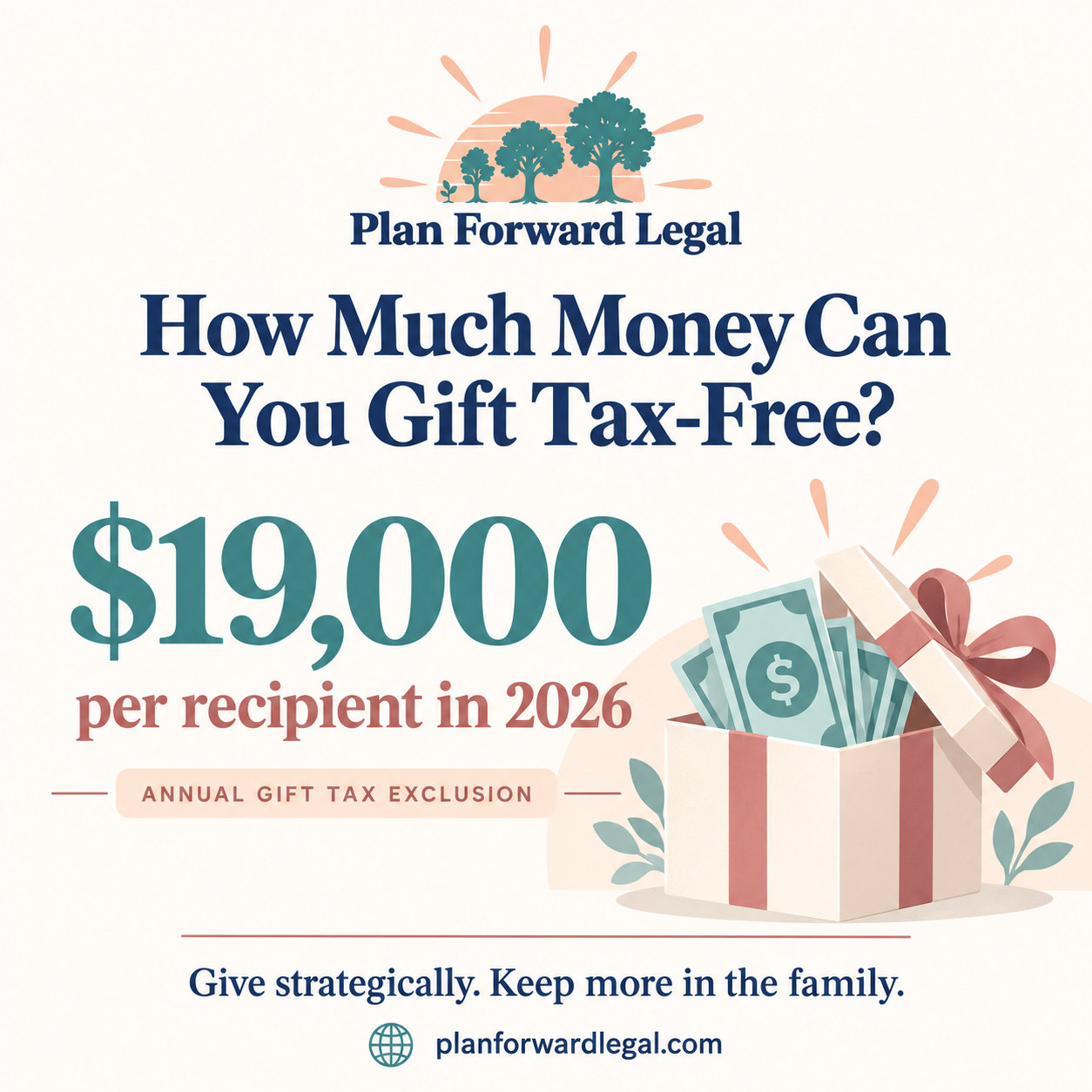
The annual gift tax exclusion amount is $19,000 per individual in 2026. That means any person can gift property valued at $19,000 or less to another person without needing to inform the IRS or file any paperwork.
As a practical matter, good record-keeping is important if you regularly make large gifts.

When You Can Make Unlimited Amounts of Tax-Free Gifts
There are some situations where gifting financial support is considered so beneficial that it is encouraged, and gifts made to certain recipients are always tax-free, regardless of the amount.
- Tuition paid directly to qualifying post-secondary schools
- Qualifying medical expenses paid directly to the provider of services
- Gifts between married individuals who are US citizens
- Contributions to qualifying charitable organizations
- Donations to eligible political organizations
Tax-free gifts made to qualifying recipients do not require any filing with the IRS. Nor do they count against an individual’s lifetime estate tax exemption ($15 million in 2026).
Taxable Gifts When the Recipient or Donor is not a US Citizen
The recipient of a gift is never legally responsible for paying tax for receiving it. The legal residency status of a gift recipient is relevant only in determining the size of a gift that triggers tax liability for the donor. The legal residency status of a donor is relevant in determining the type of gift that will trigger tax liability.
Gifts Made by Non-Citizen Lawful Permanent Residents
The federal gift and estate tax laws apply equally to donors who are lawful permanent residents or US citizens. If legal residents meet the test for being ‘domiciled’ in the US, they are treated as citizens for gift tax purposes. Whether a resident is domiciled in the US is a conclusion based on an evaluation of the resident’s presence in the US and intent to remain here.
Gifts Made by Non-Citizen Lawful Residents and Non-Residents
Non-domiciled residents and non-resident donors are only taxed on gifts of tangible property located in the United States. Gifts of intangible property, such as the stock of a US corporation, are not subject to gift tax.
The annual gift tax exclusion applies to non-domiciled residents and non-residents, but the lifetime transfer tax exemption does not, and tax must be paid when a gift to any individual exceeds the annual exclusion amount.
Gifts Made by a US Citizen Spouse to a Non-Citizen Spouse
Between US citizen spouses, there is no limit on the value of gifts that can be exchanged without incurring transfer tax. However, when the donor spouse is a US citizen and the recipient spouse is not a US citizen the unlimited marital deduction does not apply. Gifts are limited to an amount that is adjusted annually, $194,000 in 2026.
The US citizen donor spouse can still offset any gift tax owed against the balance of the lifetime gift and estate tax exclusion.
When You Need to File a Gift Tax Return
If your total gifts to one recipient during the tax year exceed the annual gift tax exclusion amount (unless they qualify as tax-free), you must file a US Gift Tax Return (Form 709) with the IRS. The good news is that you won’t owe any actual money if you have not already used up your lifetime gift/estate tax exclusion amount, which is $15 million in 2026.
The bad news is that the top marginal tax rate for gifts exceeding the annual exclusion is 40%, though you would have to make a gift exceeding the annual exclusion amount by over $1 million to achieve the highest tax rate. Gift tax rates start at 18%.
Gifting Strategies for Maximum Giving Without Incurring Tax Liability
Strategic gift giving can help reduce a potentially taxable estate during an individual’s lifetime. Combining the annual gift tax exclusion with tax-free giving to qualifying recipients allows the maximum lifetime benefit to be conferred while minimizing taxes.
Some basic gifting strategies include:
- Gift-splitting – Married couples may combine their gift tax exclusions and double the annual gift to one recipient ($38,000 in 2026).
- Super funding college savings plans – 529 plans can be front-loaded with an amount equal to five years’ worth of annual gift tax exclusions.
- Direct payments for tuition or medical treatment – gifts in the form of direct payments to schools or health care providers are not taxed and do not reduce the lifetime transfer tax exemption.
- Gifting appreciating assets – Property that appreciates can be transferred in gift tax exclusion-qualifying chunks of value over time to remove the property and its increasing value from an estate.
The IRS considers a gift complete when the donor has parted with dominion and control over the gifted property, such that the donor is unable to change the disposition of the property.
Planned Gifting Can Help Reduce Estate Tax Exposure
If you’re like many people contemplating where you want your property to go when you die, you want to benefit the people and causes that are most important to you. You don’t want to give any more than is necessary to any government agency.
Planned gifting allows you to enjoy helping those you care about during your lifetime and reduces your estate, minimizing your exposure to estate tax after your death. To learn more about the benefits of lifetime gifting, contact the Chicago estate planning attorney at Plan Forward Legal.


