
When a will is the estate planning tool used to transfer property at death, probate is the court-supervised process that legally transfers property ownership from a deceased person to the appropriate recipients.
For those who want to avoid probate in Illinois, there are other estate planning tools that can do everything a will can, but without requiring court supervision. The Chicago probate attorney at Plan Forward Legal explains why you may want to avoid probate and instead use one or more of the probate alternatives in Illinois.
Why Do People Want to Avoid Probate?
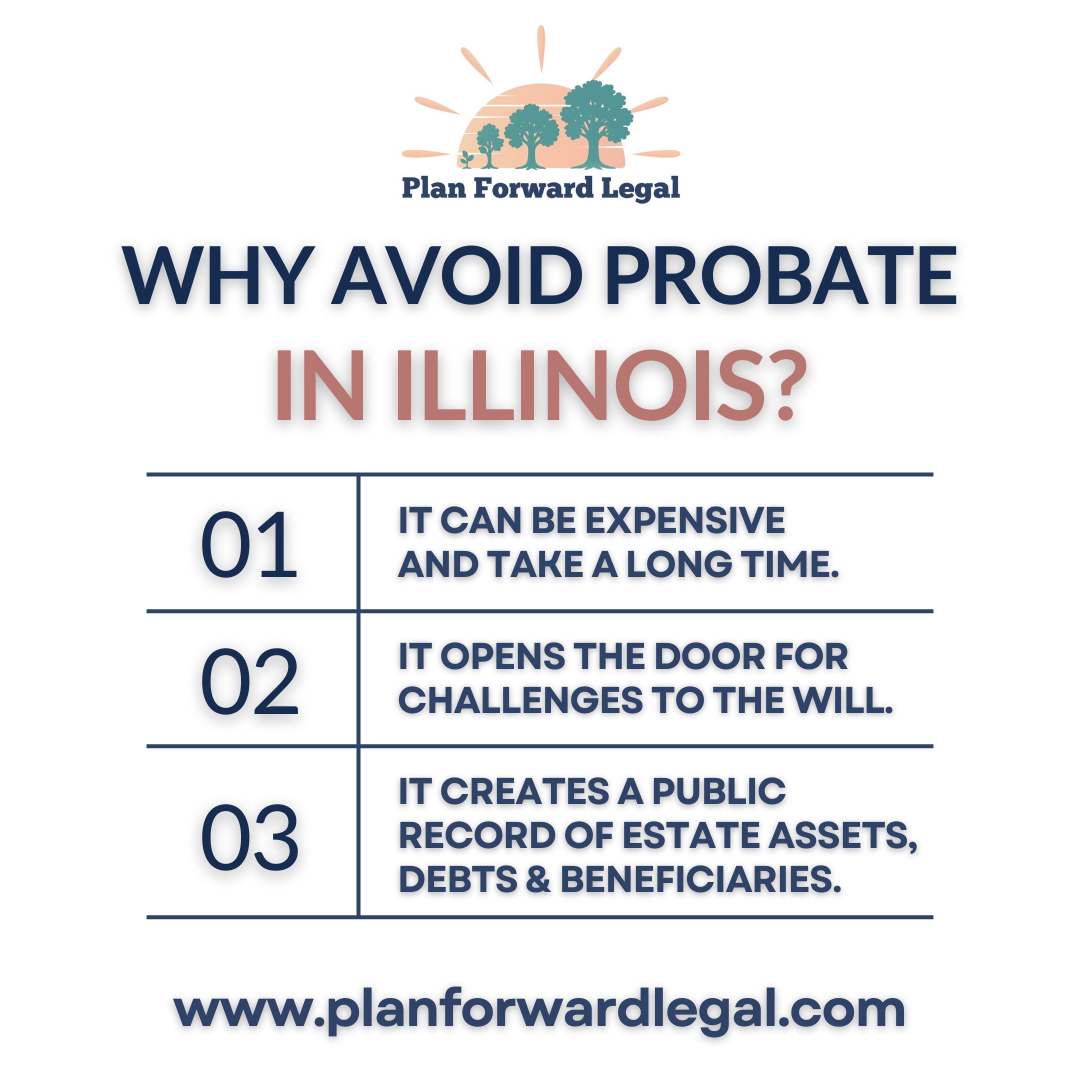
If you’ve ever done any research on estate planning or asked someone for an opinion, you probably learned that you want to avoid probate because it can be expensive and take a long time. Probate also opens the door for creditors and disgruntled family members to challenge the validity of a will. Furthermore, probate creates a public record about an estate’s assets, debts, and beneficiaries.
So there are some good reasons to consider avoiding probate when doing estate planning. However, it’s necessary to evaluate individual and family needs to determine whether to use a will or whether estate planning to avoid probate is appropriate.

Estate Planning to Avoid Probate in Illinois
If you are wondering how to avoid probate, the following alternatives are ways to transfer property at death and achieve Illinois probate avoidance.
Small Estate Affidavit
The small estate affidavit can be used whether or not a decedent had a will. The qualifying factors are the value and type of the estate’s assets. The small estate affidavit will not transfer real property.
Effective August 15, 2025, the value of qualifying small estates increased to $150,000 and now it allows a SEA to help transfer title of vehicles without including the value fo the vehicle to the estate. This change in the law is intended to make it easier for families to use the small estate affidavit in Illinois and avoid probate.
Typically, the person named in a will or an heir completes the affidavit and states that the required information is accurate, including the following:
- Any known will has been filed with the county clerk within 30 days of the decedent’s death.
- The probate process has not been started.
- The estate has no unpaid debt, or all known unpaid debts are listed and will be paid before any distribution to heirs.
If an otherwise qualifying small estate contains real estate held solely in the name of the decedent, probate is necessary to transfer title to the real property.
Revocable (Living) Trust
If you own property or have assets valued over $150,000, a revocable trust in Illinois can be created during the life of the grantor (trust creator). The grantor can also change or terminate the trust during the grantor’s lifetime. Property transferred to the trust remains fully available to the grantor, who is free to add and remove property while living.
Upon the grantor’s death, the trust becomes irrevocable. Property in the trust is then managed or distributed in accordance with the trust’s terms.
Besides avoiding probate, a trust keeps a family’s business private and is less prone to legal challenge than a will. Trusts are also a good way to hold and transfer out-of-state real estate that would otherwise be subject to probate in another state.
Real Property Transfer on Death Instrument (TODI)
Illinois law allows the individual owner of an interest in real property to execute a transfer on death instrument (TODI), which will legally transfer title to the real estate upon the owner’s death without the need for probate. The owner must sign the TODI in the presence of witnesses and a notary public, and file it with the county recorder in the county where the property sits.
During life, the property owner retains the right to revoke the TODI or change beneficiaries. The property will pass to the beneficiary, subject to any outstanding debts, and must be formally accepted to become effective.
Joint Ownership with Rights of Survivorship
Personal property and real estate can be owned jointly by two or more people, each of whom is considered an owner of the entire property. Upon the death of any owner, the remaining property immediately vests in the surviving owners.
To create joint ownership with survivorship rights for most personal property and for real estate, the intention to create a joint tenancy with right of survivorship must be clearly stated in the ownership documents.
Certain types of personal property are legally considered to be owned in joint tenancy with rights of survivorship in Illinois when owned by more than one person. They include:
- Deposits in a bank or trust company held in the name of two or more persons
- Stocks, bonds, or other evidence of indebtedness issued by a corporation to two or more persons as joint tenants with right of survivorship
- Non-transferable US Savings bonds issued to two or more persons
- Motor vehicles owned by two or more persons
Tenancy by the entireties is a form of joint ownership with survivorship rights that is available only to married couples. It only applies to a primary residence and protects the home from the separate debts of one spouse. Married couples who wish to own their primary residence in tenancy by the entireties must specifically state their intention in the property deed.
Beneficiary Designations
Certain types of personal property accounts, such as life insurance policies and retirement accounts, allow the policy or account owner to designate a pay-on-death beneficiary, which allows the property to bypass probate and go directly to the named beneficiaries. This means the beneficiaries receive the money outright, subject to any creditors or lawsuits present in the beneficiary’s life.
Whether Your Estate is Big or Small, Plan Forward Legal has Solutions for All
In most cases, with proper planning, people who wish to avoid probate can achieve their goal. Putting together the right plan depends on the value of the estate, the types of property owned, and the wishes of the people involved.
At Plan Forward Legal, we work with all types of estate planning clients. We can help put together an individualized plan, review an existing plan, or answer questions to ensure clients understand what will happen and where changes may be needed in the future. We’re competent, friendly, and here to help. Call us.


