

Estate planning is often framed as paperwork about money. In reality, it is about something much more personal. It is about who gets to speak for you, who is protected, and whether the people you love are recognized when it matters most.
For many LGBTQ+ individuals and families, the legal system does not automatically reflect the way your life is actually structured. Chosen family, long-term partners, co-parents, and community ties can be invisible to default legal rules. When documents are missing or outdated, the gap between your real life and the legal system can become painfully clear.
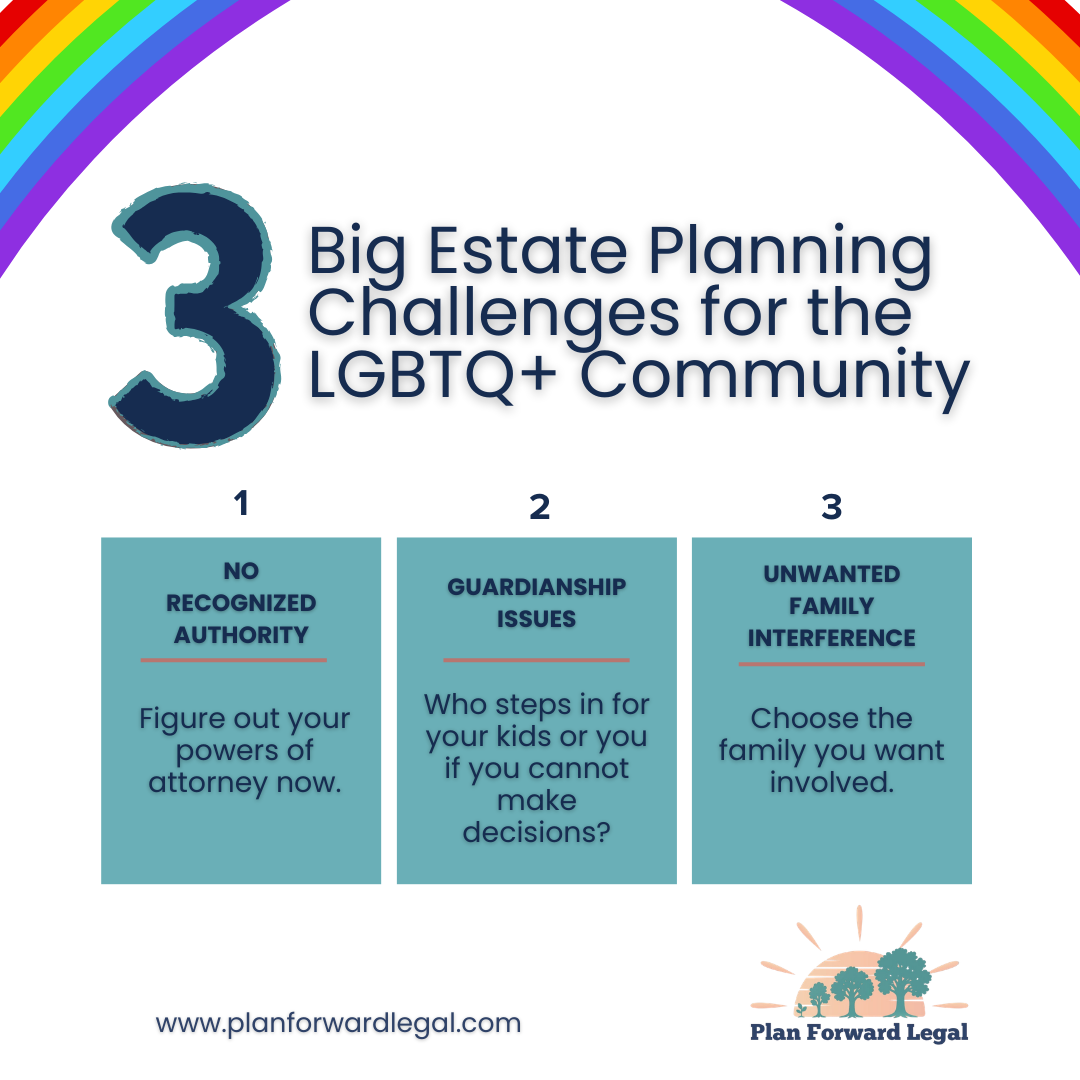
Today, we’ll touch on three LGBTQ estate planning challenges we see come up again and again, and why proactive planning matters.
- 1. Lack of Recognized Authority When It Matters Most
- 2. Guardianship Issues and Court Control
- 3. Potential Unwanted Family Interference
- Why These Challenges Are Not Just Theoretical
- What Good Planning Looks Like
- Your Life, Your People, Your Plan

1. Lack of Recognized Authority When It Matters Most
In everyday life, your partner or chosen family may be the person who handles everything. They know your medical history. They pay bills. They manage logistics. But without the right legal authority in writing, institutions do not have to recognize that relationship, no matter how long you’ve had the arrangement.
Hospitals, banks, and courts follow formal rules. If your documents are not in place, they default to legal next of kin, even if that person is not part of your daily life.
A medical power of attorney and financial power of attorney give someone the legal right to act on your behalf if you cannot speak for yourself. Without them, your closest person may have no authority at all. You can dig further into who you should choose for those roles in our blog.
How This Might Look IRL
Jordan and Chris had been together for 14 years and owned a home together. When Jordan experienced a sudden stroke, Chris assumed they would be involved in medical decisions. At the hospital, staff repeatedly turned to Jordan’s estranged sibling because no health care power of attorney existed. Chris had to wait in the hallway while decisions were being discussed. The emotional impact of being treated like a stranger in a crisis stayed with them long after Jordan recovered.
This situation is preventable. Authority should never be left to assumption. It needs to be written clearly and executed properly so there is no question about who speaks for you.
2. Guardianship Issues and Court Control
Guardianship becomes an issue when someone cannot make decisions for themselves, or when minor children are involved. If you have not formally nominated who should step in, a judge will decide.
Courts do their best, but they are working with limited information. They look at legal relationships first, not emotional ones. For LGBTQ+ families, especially those with blended structures or non-biological parents, this can create real risk.
Guardianship nominations in your estate documents allow you to choose who would care for your children or make decisions for you if you become incapacitated. Without those nominations, your voice is missing from the process.
How This Might Look IRL
Morgan and Elise were raising Elise’s daughter from a prior relationship. Morgan had been in the child’s life since kindergarten and was the daily caregiver. When Elise was seriously injured in an accident, Morgan assumed they could continue making school and medical decisions. Instead, a distant biological relative petitioned the court for temporary guardianship because there was no formal nomination in place. The court process was stressful, public, and disruptive for the child at a moment when stability mattered most.
Guardianship planning is not about expecting the worst. It is about making sure the people you trust are legally recognized if something unexpected happens.
3. Potential Unwanted Family Interference
Even when relationships are clear in your personal life, the law has its own default inheritance rules. If someone dies without a valid will or trust, assets pass according to state statutes. Those statutes prioritize biological relatives and legal spouses. Chosen family is often left out.
Family interference can also happen when documents are unclear or easy to challenge. Disputes over funeral arrangements, property, or personal items can escalate quickly. What should be a time of grieving becomes a legal battle.
Strong estate planning reduces the risk of conflict. Clear documents, updated beneficiary designations, and properly structured trusts make your intentions difficult to misinterpret or contest.
How This Might Look IRL
Riley had a close-knit circle of friends who functioned as family. They shared holidays, finances, and caregiving responsibilities. Riley always said they wanted their partner and friends to inherit their assets. But Riley never finalized a will. After Riley’s death, an unsupportive parent inherited everything under state law. The people who had been Riley’s daily support system had no legal standing to challenge the outcome.
The heartbreak in situations like this is not just financial. It is about identity and recognition. Estate planning is one of the few ways to make your chosen family legally visible.
Why These Challenges Are Not Just Theoretical
It is easy to assume that marriage equality solved most legal concerns. While it was a major milestone, it did not erase the importance of individualized planning. Many LGBTQ+ people are unmarried, part of blended families, or connected through chosen family structures that the law does not automatically understand.
Even married couples need updated powers of attorney, guardianship nominations, and coordinated beneficiary designations. Marriage alone does not cover every situation. Gender identity, parentage recognition, prior relationships, and interstate moves can all complicate default rules.
Estate planning is not about fear. It is about clarity. It is about making sure your legal documents match the reality of your life.
What Good Planning Looks Like
Effective planning is practical and tailored. It uses a combination of tools that work together:
- Durable financial power of attorney so someone you trust can manage finances if needed
- Health care power of attorney and advance directives so medical decisions stay in the right hands
- HIPAA authorizations so your chosen person can access medical information
- Guardianship nominations to protect children and dependent adults
- Wills and revocable living trusts to control asset distribution
- Updated beneficiary designations on retirement accounts and insurance
Each of these documents closes a gap where default law might otherwise override your wishes. Together, they create a plan that recognizes your relationships and protects your autonomy.
Your Life, Your People, Your Plan
Estate planning is an act of care. It says, in writing, who matters to you and how you want to be protected. For the LGBTQ+ community, that protection is not abstract. It is deeply personal.
A thoughtful plan ensures your partner is not treated like a stranger. It keeps courts from guessing about your family. It reduces the chance that unsupportive relatives can rewrite your story. Most importantly, it gives you peace of mind. You get to decide. Your voice carries forward, even in moments when you cannot speak for yourself.
If you have been putting this off, you are not alone. Many people do. The good news is that once a plan is in place, the relief is immediate. Your documents become a legal reflection of the life you have built and the people you love.


