
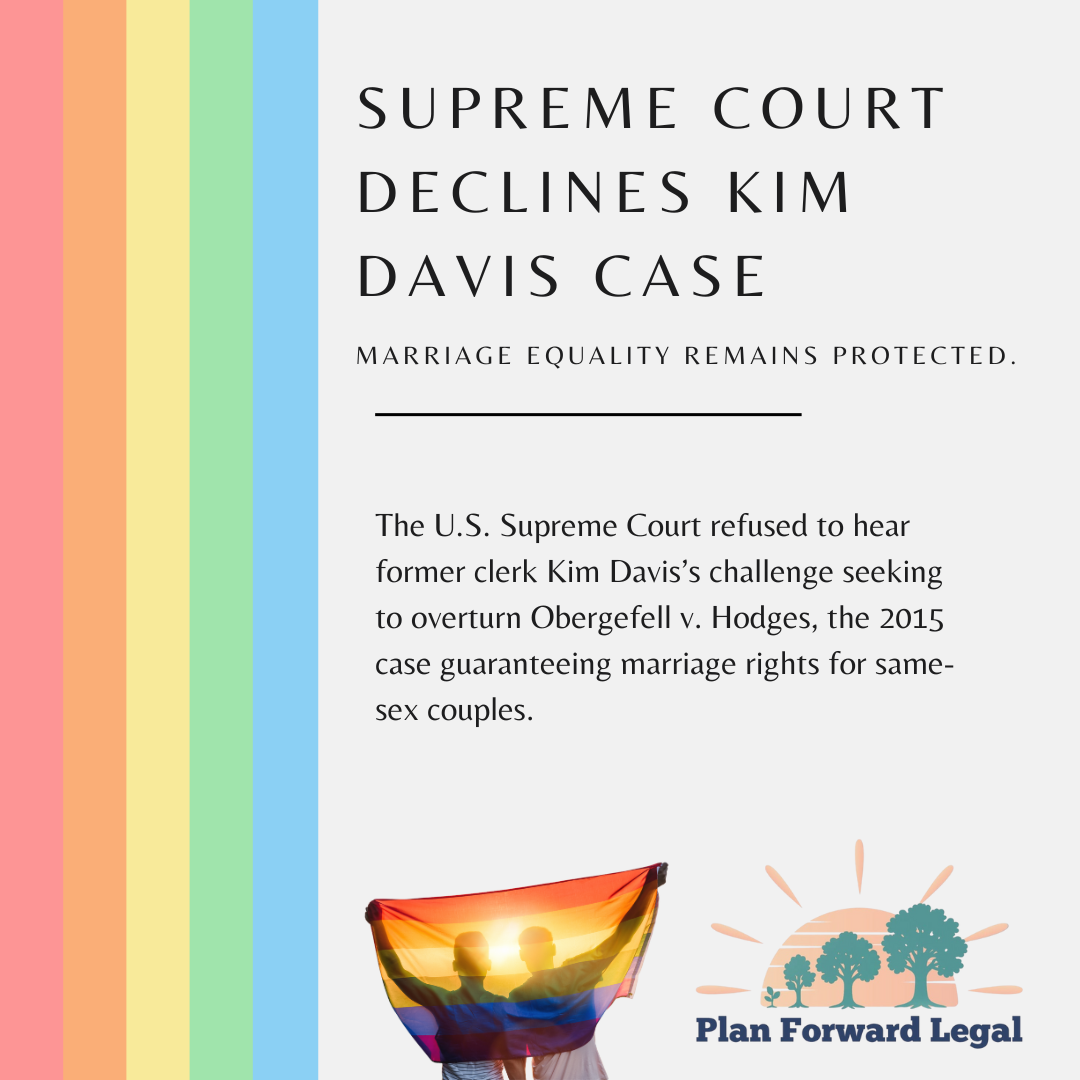
On November 10, 2025, the United States Supreme Court denied the request of a former county clerk from Kentucky who had petitioned the Court to reconsider its 2015 decision recognizing same-sex marriage as a constitutional right. We’ve been waiting for this Supreme Court same-sex marriage ruling.
While the Supreme Court’s affirmation of its previous decision is a relief for members of the LGBTQ+ community, there remains continued pressure from state governments and religious organizations that fervently oppose marriage equality.
Recent changes in long-standing legal precedents have shown that legal rights once granted can just as easily be taken away. The uncertainty is unsettling to say the least, but for now, the Supreme Court has doubled down on its commitment to marriage equality.
At Plan Forward Legal, our LGBTQ+ estate planning attorney supports individual freedom and is committed to helping all families ensure a secure future, even amid changing legal environments.

Marriage Equality is the Law in the United States
In Obergefell v. Hodges (Obergefell), the petitioner asked the Supreme Court to determine whether states that defined marriage as a union between a man and a woman and refused to recognize same-sex marriages legally obtained out of state were violating the fundamental freedoms of same-sex couples as guaranteed by the 14th Amendment.
In previous decisions, the Supreme Court has recognized the right to marry as a fundamental right protected by the Due Process Clause of the 14th Amendment and has said that states may not impose regulations that unreasonably interfere with an individual’s decision to enter into the marital relationship.
The Court affirmed in Obergefell that the right to marry is a fundamental individual liberty protected by the Constitution. It acknowledged the traditional custom of marriage being a union between a man and a woman, yet decided conventional beliefs about the institution of marriage cannot justify infringing on an individual’s exercise of a fundamental freedom.
The Court ruled:
- Same-sex couples may exercise the fundamental right to marry.
- State laws are invalid to the extent they do not give same-sex and opposite-sex couples the same marriage rights.
- States must recognize same-sex marriages validly performed out of state.
The decision was not unanimous. Four of the nine justices dissented, believing the Constitution did not give same-sex couples the fundamental right to marry. The dissenters believed marriage equality was properly an issue of state law and accused the majority of judicial overreach.
A Kentucky County Clerk Refuses to Issue a Marriage License to a Same-Sex Couple
Obergefell became law in June of 2015. Less than a month later, a same-sex couple applied for a marriage license in Rowan County, Kentucky. Although clearly made aware of the new law and instructed to comply, county clerk Kim Davis (Davis) refused to issue David Ermold (Ermold) and David Moore (Moore) a marriage license based on her religious beliefs.
Ermold and Moore sued Davis for violating their constitutional right to marry and sought damages in federal Court. Davis claimed that issuing a marriage license to Ermold and Moore would have violated her First Amendment right to exercise her religion freely.
The district court denied First Amendment protection for Davis because she was acting on behalf of the government when she refused to issue the marriage license. She was found personally liable to Ermold and Moore and ordered to pay compensatory damages.
Davis appealed both liability and damages. The Sixth Circuit appeals court affirmed the district court decision. Davis petitioned the Supreme Court to reconsider the denial of her First Amendment defense and consider overturning Obergefell.
The Supreme Court denied Davis’s petition without comment or explanation, which is not unusual given the large number of petitions the Court must consider. All that can be known for sure is that fewer than four of the justices thought the issues were important enough to require the Court’s attention at this time.
How Changes in Marriage Equality Laws Could Affect Same-Sex Marriages in Illinois
Fortunately for same-sex couples seeking to marry or have their marriage recognized in Illinois, marriage equality was on the books even before the Supreme Court decided Obergefell. The Illinois Religious Freedom and Marriage Fairness Act took effect in 2014, providing full marriage equality to same-sex couples.
However, if Obergefell were to be overturned in the future, there are many states surrounding Illinois that are poised and ready to ban marriage equality. Ten years later, 32 states still have either legislative or constitutional bans on marriage equality just waiting to become law again.
Some states are doing more than standing by. Earlier this year, NBC News reported there were at least nine states actively introducing legislation trying to prevent same-sex marriage. Michigan, Idaho, Montana, North Dakota, and South Dakota have introduced measures aimed explicitly at overturning Obergefell.
Federal Respect for Marriage Act
Congress passed the Respect for Marriage Act (RFMA) in 2022. For purposes of federal law, the RFMA recognizes as married any two individuals whose marriage was legal when entered into. It further requires all states to recognize the legality of out-of-state marriages and prohibits denying full faith and credit to an out-of-state marriage on the basis of sex.
If Obergefell falls and states are once again able to ban marriage equality, they will not be able to deny valid marriages between individuals. The RFMA authorizes the Department of Justice to bring civil actions and creates a private right of action for those who experience violations of the law.
Plan Forward Legal Helps You Protect Everyone and Everything You Love
The team at Plan Forward Legal believes in love and families and advocates interpreting laws to promote what is fair and just in the world we live in today. We applaud the Supreme Court for recognizing that the human experience is ever-evolving and for protecting the fundamental right of an individual to freely choose a marital partner.
The Chicago estate planning attorney at Plan Forward Legal offers comprehensive estate planning services in the greater Chicago area. Whether your family is traditional or non-traditional, Plan Forward Legal welcomes the opportunity to assist with planning for your lives today, as well as making sure your family is protected into the future.


