
Powers of attorney (POA) are created so that a trusted individual is available to make legal decisions for a person who is no longer able to act for themselves. The agent appointed under a power of attorney is legally required to carry out their responsibilities with the utmost good faith.
However, not all agents abide by the rules. Often, agents are family members, and they may have different ideas about how to use their power. Power of attorney abuse occurs when an agent acts in any way that does not benefit the person on whose behalf they are acting.
Power of attorney abuse can be a tricky situation to deal with because it can pit family members against each other. At Plan Forward Legal, we counsel our estate planning clients about the importance of careful agent selection when executing a power of attorney.
Powers of Attorney in Illinois
A power of attorney is granted by a competent individual (principal) to a trusted person (agent) so the agent can manage financial or health care decision-making. Powers of attorney are often created as part of a comprehensive estate plan to manage the risk of future incapacity.
An agent has only the authority granted by the power of attorney. An agent’s authority can be very broad (general) or narrowed to specific tasks (limited). The document itself determines what the agent can do. If an agent exceeds their authority, their transactions may be voided, their authority may be revoked, and they may face legal liability.
At the time an agent needs to step in and act, the principal may not be able to monitor the agent’s activities and will have to rely on the agent’s integrity. An available opportunity and a perceived lack of accountability may encourage an agent to act inappropriately.
Legal Duties Owed by an Agent to a Principal
The Illinois Power of Attorney Act specifies the standard of care by which an agent is to exercise their responsibilities. The statute says:
“…the agent shall act in good faith for the benefit of the principal using due care, competence, and diligence in accordance with the terms of the agency and shall be liable for negligent exercise.”
The due care requirement is of paramount importance. As long as an agent acts with due care, they are not liable merely because they may also benefit from actions they are taking on behalf of the principal or have personal interests in some of the property or affairs they are managing.
Agents must act in accordance with the expectations of the principal, if known, and always in the best interests of the principal. Agents must keep detailed records of their actions and be prepared to provide a copy when legally required.
An agent who fails to act appropriately will be liable to the principal or the principal’s successor in interest for the value of the damage done to the principal, plus attorney’s fees. An agent may also face criminal charges.
Warning Signs of Power of Attorney Abuse
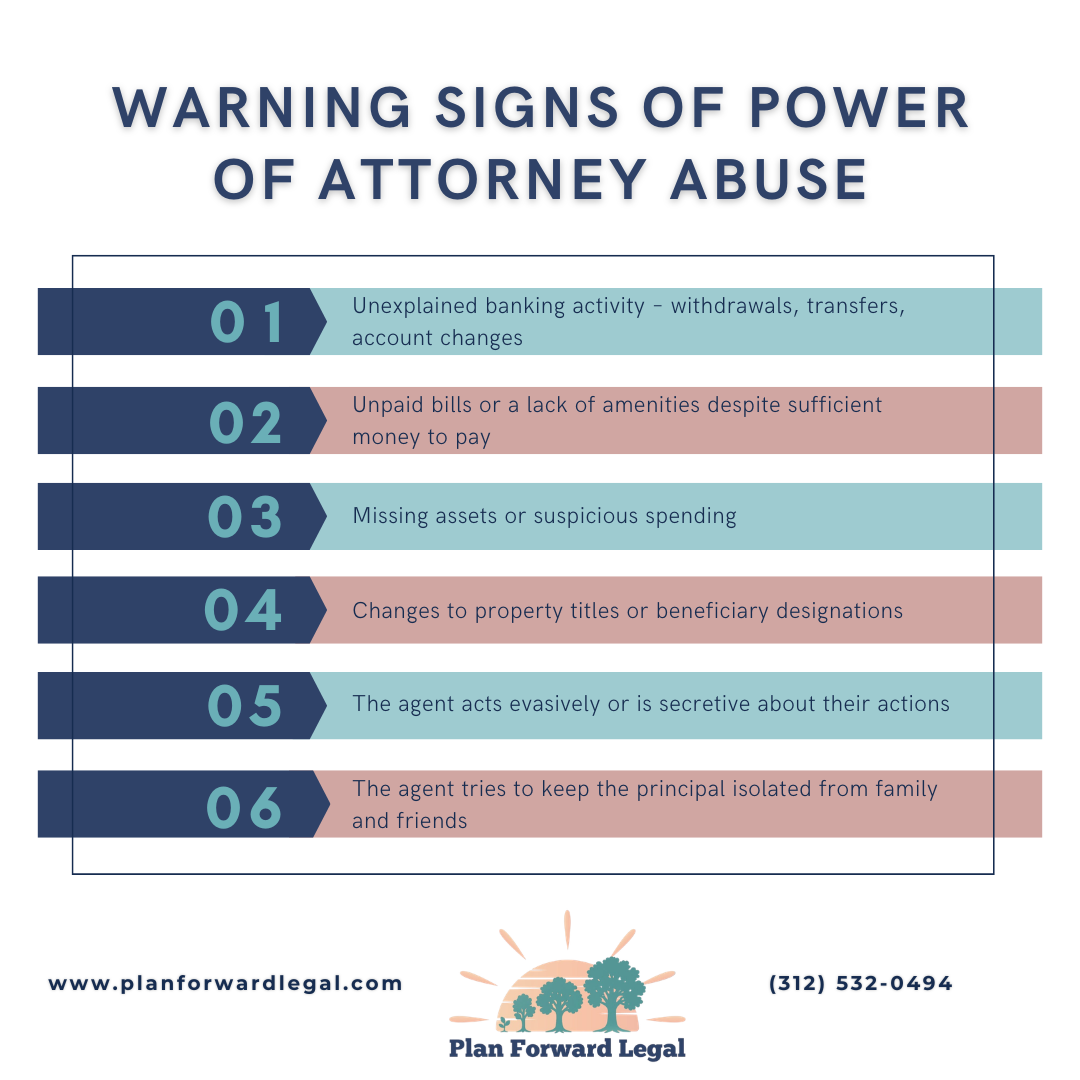
Warning signs that an agent may be abusing a power of attorney are not always easy to spot. Principals and agents may live in different places, and one or the other may not have frequent contact with people who could recognize a problem. Some power of attorney abuse red flags can include:
- Unexplained banking activity – withdrawals, transfers, account changes
- Unpaid bills or a lack of amenities despite sufficient money to pay
- Missing assets or suspicious spending
- Changes to property titles or beneficiary designations
- The agent acts evasively or is secretive about their actions
- The agent tries to keep the principal isolated from family and friends
Family and friends would be the people most likely to notice when things don’t seem right.

What to Do if Power of Attorney Abuse is Suspected
If power of attorney abuse is suspected, there are several ways to proceed, depending on the circumstances.
Request a Review of the Agent’s Records
The principal, various government agencies, and any ‘interested’ person (via court petition) have the right to request an accounting of an agent’s actions. Interested persons include certain family members, potential heirs or beneficiaries, and other legal representatives.
An agent that fails to comply with an authorized records request without good cause can be ordered to pay costs, attorney’s fees, and other relief the court deems appropriate.
If an interested party petitions the court and the court determines that the principal lacks the capacity to control or revoke the power of attorney, the court can review the POA and the agent’s conduct and grant relief, such as compensatory damages.
Contact a Government Agency
Abuse or exploitation of an adult age 60 and older or a person with disabilities ages 15-59 can be reported to Adult Protective Services. If the abuse is connected to a long-term care facility, the Long Term Care Ombudsman Program may be able to help.
The Illinois Department of Human Services (IDHS), Office of the Inspector General (OIG), investigates abuse and financial exploitation of adults with disabilities in mental health or developmental disability programs.
Report to Police
If power of attorney abuse rises to the level of theft, forgery, or fraud, a crime has been committed.
The crime of financial exploitation of an elderly person or a person with a disability occurs when a person placed in a position of trust or confidence knowingly takes control of the vulnerable person’s property by deception or intimidation, or illegally uses their assets or resources. The crime is a felony of increasing severity as the value of the property and the victim’s age increase.
How You Can Minimize the Opportunity for Power of Attorney Abuse
It’s too bad that people have to act the way they do sometimes, especially when they have been entrusted to do the right thing. There may be no way to know for sure how someone will act when given power, but a combination of careful selection and checks and balances built into the POA will minimize opportunities for misappropriation.
When creating a POA, the following considerations will help minimize the potential for power-of-attorney abuse.
- Give due consideration to the person(s) or entity you select as your agent
- Consider selecting co-agents
- Require periodic oversight by a non-interested party (and make sure the party gets a copy of your POA)
- Be specific about what the agent is not authorized to do
- Require co-signatures for certain types of transactions
- Specify the circumstances under which an agent will lose their authority
- Appoint a successor agent
You always want to be confident that you are making good decisions and can count on the people you trust. At Plan Forward Legal, we want you to feel confident, which is why we do the verifying. Consult an estate planning attorney at Plan Forward Legal. We’ll make sure you’ve got your back in case anything unexpected happens.


