
When your spouse passes away, you face the burden of trying to live without their love, support, and financial assistance. The state of Illinois provides assistance, commonly known as a widow’s allowance. Yet what is a widow’s allowance, and what do you need to know as a surviving spouse?
Our Chicago probate attorney at Plan Forward Legal can assist you in understanding the funds available to you during the probate process after losing your partner, including a spouse’s award, pension payouts, and Social Security benefits.

Illinois Provides Support for Widows and Widowers
According to the Social Welfare History Project, Illinois was the first state to pass a law establishing a spousal award, or widow’s allowance, for those mothers who had lost their husbands. Previously, states and cities like New York City had gone back and forth about instituting government funding rather than encouraging private charitable organizations to provide this assistance.
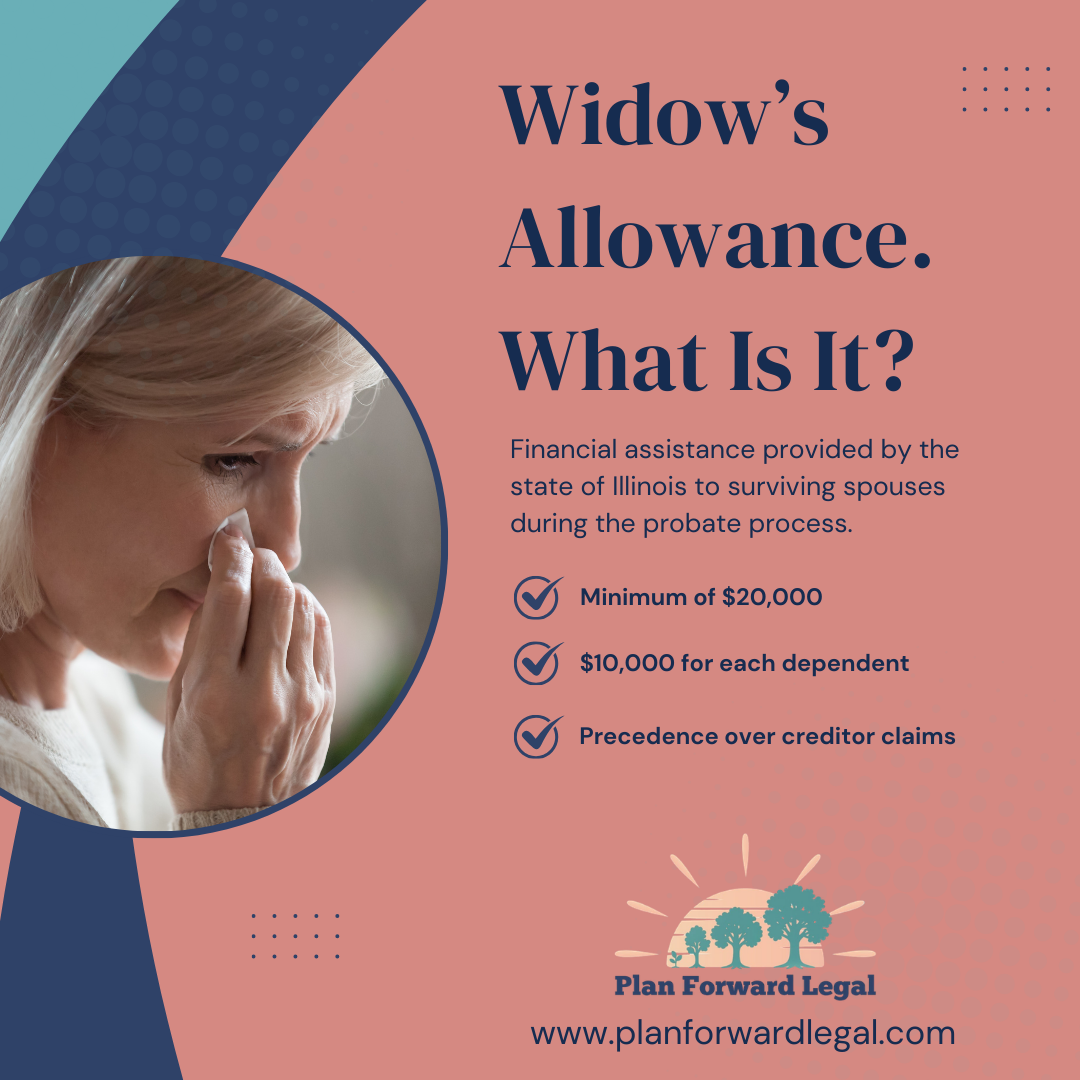
Today, the spousal award is available for all surviving spouses of traditional marriages and civil unions, under 755 ILCS 5/15-1. The minimum amount available is $20,000, paid in 3 installments over the 9 months following the death. The Circuit Court for the county where your spouse died (such as Cook County) may award more, depending on the following factors:
- Your spouse’s standard of living
- The size of the estate
- Your financial needs
- Whether you have dependent children
You receive $10,000 for each dependent child, and you receive your spouse’s award even if your spouse tries to cut you out of their will. The goal is to provide support during the probate process until you close the estate. A spouse’s awards take precedence over creditor claims during probate, so you don’t have to worry about doing without to pay for your immediate needs.
You May Also Qualify for Other Benefits, Depending on Your Spouse’s Work
On top of the widow’s allowance, you may qualify for benefits from other sources, such as pensions, retirement funds, or life insurance policies if your spouse named you as the beneficiary for these. Those proceeds go directly to you without passing through probate.
Various employment fields also offer spousal benefits, including the following:
- Policeman’s Annuity & Benefit Fund of Chicago
- Laborers’ & Retirement Board Employees’ Annuity & Benefit Fund of Chicago
- Cook County Employees’ and Officers’ Annuity and Benefit Fund
- Illinois State Employees’ Retirement System (SERS)
- Teacher’s Retirement System of the State of Illinois
- State Universities Retirement System
You could also receive your spouse’s benefits from the Social Security Administration (SSA) under certain circumstances and depending on your spouse’s work history. Generally, you must be at least 60, have been married for at least 9 months before the death, and have not remarried. You’ll be eligible for the minimum death benefit of $255, but you could receive as much as 90% of your spouse’s retirement payments.
The 2025 Social Security Fairness Act Protects Your Benefits
Passed in January 2025, the Social Security Fairness Act eliminates the previous Government Pension Offset (GPO) and Windfall Elimination Provision (WEP). These two often reduced surviving spouses’ benefits from pension programs to very little or even nothing.
This Act is retroactive to 2024, so if you are managing an estate for someone who passed away in 2025, you may have retroactive benefits due if your spouse qualified for public employee pension or retirement program payments. In addition, if you are already receiving your own pension that you paid into instead of Social Security, you can continue to receive those benefits, according to the SSA’s frequently asked questions.
Filing for a Spouse’s Award and Other Benefits
One of the most trying parts of dealing with a spouse’s death is the amount of paperwork. The emotional burden can leave you unsure of what to do, yet you need to pursue everything you’re entitled to receive. Unfortunately, each individual death benefit requires its own application and has a different process.
You must start with understanding probate and how it will affect your spouse’s estate. Probate is the legal way to transfer property unless it’s owned by a trust or transferred through another method (such as joint tenancy on your home). Here are the basics of probate in Illinois:
- Find the will or verify that your spouse died without a will (intestate).
- Obtain the death certificate.
- File your petition with the probate office for the county where they died, naming who will serve as the estate’s executor.
- If you’re the executor, submit the required documents and follow the probate procedures.
- Make an inventory of all your spouse’s assets, debts, and any creditor claims against the estate.
- Coordinate with trustees if your spouse used trusts instead of a will to transfer property.
- File taxes, pay debts, maintain assets, and distribute property according to the will or Illinois descent and distribution laws (755 ILCS 5/2-1) if there isn’t a will.
- Close the estate.
Sometime during all of this, you also have to find time to apply for spousal awards. Fortunately, you can work with an experienced probate attorney who will help you collect everything you need. They can also assist you with completing the forms and submitting them according to the requirements.
The Spouse’s Award Is Your Right, Regardless of What Else Happens With the Estate
In Illinois, how long the probate process lasts depends on a number of factors, including whether your spouse held complex assets, whether heirs contest the will, and whether you have the option to avoid probate. No matter how difficult it is to manage the estate, you still have the right to request your spouse’s award and can request appropriate increases to match your financial needs.
You don’t have to face the overwhelming challenges of probate, benefits, and other matters after losing your spouse without help. At Plan Forward Legal, our team is ready to assist you with compassion, honesty, and respect. We focus on guiding all families, including those in the LGBTQIA+ community. Arrange a consultation with a skilled Chicago probate attorney when you contact us today.


